30 Days JavaScript Roadmap for Beginners (2026) -Free PDF Download
Why Learn JavaScript?
JavaScript is the only programming language that runs natively in every web browser. It is what turns a static HTML page into a live, interactive experience from form validation and animated menus to full single-page applications. Knowing JavaScript opens doors to frontend development, backend development with Node.js, mobile apps with React Native, and more. According to the Stack Overflow Developer Survey, JavaScript has been the world's most-used programming language for over a decade making it one of the highest-return skills you can invest time in.
- ✦Build interactive, dynamic websites
- ✦Create rich user interfaces without plugins
- ✦Consume REST APIs and external data sources
- ✦Power modern frameworks: React, Next.js, Vue
- ✦Run server-side code with Node.js
- ✦Develop cross-platform mobile applications
How to Use This Roadmap
Spend 30 to 60 minutes on each day's topic. Read the concept, then immediately write the code yourself don't copy-paste. Repetition and hands-on practice are what cement knowledge. If a day's topic feels too easy, spend the extra time building a small experiment. If it feels difficult, that's normal re-read, try again, and move on. Progress matters more than perfection.
30-Day Learning Plan
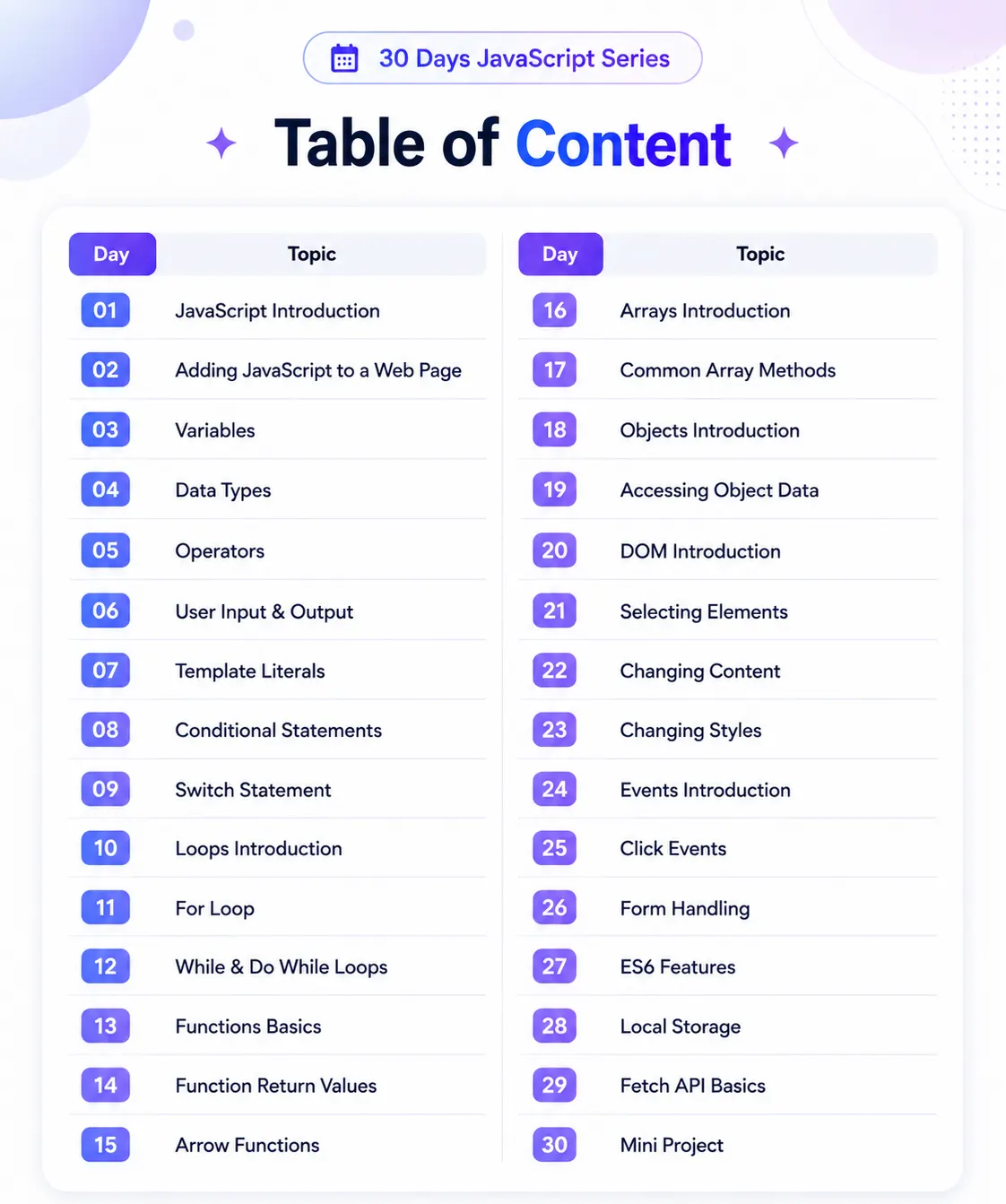
Five focused weeks, each building directly on the last.
JavaScript Fundamentals
- 1JavaScript Introduction
- 2Adding JavaScript to a Web Page
- 3Variables
- 4Data Types
- 5Operators
- 6User Input & Output
- 7Template Literals
Build your foundation by understanding how JavaScript runs in the browser, how to store and manipulate data, and how to integrate scripts into HTML pages. By the end of this week you'll be writing your first real JavaScript code.
Logic and Functions
- 8Conditional Statements
- 9Switch Statement
- 10Loops Introduction
- 11For Loop
- 12While & Do While Loops
- 13Functions Basics
- 14Function Return Values
Programming is about making decisions and repeating work automatically. This week you'll learn how your code can branch based on conditions, iterate over data, and organise logic into reusable functions and skills that underpin every application ever written.
Modern JavaScript & Data Structures
- 15Arrow Functions
- 16Arrays Introduction
- 17Common Array Methods
- 18Objects Introduction
- 19Accessing Object Data
Arrays and objects are everywhere in real JavaScript codebases. You'll learn to group related data, loop through collections, and use modern ES6 arrow-function syntax that you'll encounter constantly in React and other frameworks.
DOM Manipulation
- 20DOM Introduction
- 21Selecting Elements
- 22Changing Content
- 23Changing Styles
- 24Events Introduction
- 25Click Events
- 26Form Handling
This is where JavaScript becomes truly exciting. The Document Object Model lets you read and rewrite the page in real time swapping text, toggling classes, and reacting to every click, keypress, and form submission the user makes.
Modern Development Features
- 27ES6 Features
- 28Local Storage
- 29Fetch API Basics
- 30Mini Project
Cap off the roadmap by mastering the modern browser APIs used in every professional project. You'll persist data between sessions with Local Storage, pull live data from external APIs with Fetch, and tie it all together in a mini project you can add to your portfolio.
Mini Projects You'll Build
Reading about JavaScript is only half the job. Building projects forces you to connect concepts, troubleshoot real bugs, and experience the satisfaction of a working app. Each of these projects is small enough to finish in an afternoon but rich enough to combine multiple skills at once variables, functions, DOM manipulation, event handling, and data storage. Completed, they make a solid foundation for your developer portfolio.
To-Do List
Add, complete, and delete tasks with local-storage persistence.
Counter App
Increment, decrement, and reset a counter using click events.
Quote Generator
Fetch a random quote from a public API and display it dynamically.
Skills You'll Gain
By Day 30 you'll be comfortable with every core JavaScript concept employers and frameworks expect you to know.
What to Learn Next
JavaScript is the gateway, not the destination. Once you're comfortable with the fundamentals, the natural progression is React for component-based UIs, then Next.js for server-rendered applications. Add TypeScript to catch bugs at compile time, Git and GitHub to manage your code professionally, and Node.js to start working on the server. Each technology you pick up after these 30 days will build on what you've already learned you'll be surprised how fast you advance once the foundation is solid.
Tips for Staying Consistent
The biggest reason beginners fail is inconsistency, not difficulty. Thirty minutes every day beats a five-hour Sunday binge every time. Block a fixed slot in your calendar, treat it like a class you've already paid for, and protect it. When you hit a concept that confuses you, don't skip ahead sit with it, search for a second explanation, and try to write an example yourself. Confusion is a sign you're at the edge of your understanding, which is exactly where learning happens.
Keep a learning journal. After each day, write one sentence about what you learned and one thing that surprised you. Looking back at Day 1 from Day 30 is one of the most motivating experiences a new developer can have.
Frequently Asked Questions
Common questions from people starting this roadmap.
Do I need any prior coding experience to start?+
No. This roadmap assumes zero programming background. Day 1 starts with what JavaScript is and how to run it — everything builds from there.
How much time do I need each day?+
Plan for 30 to 60 minutes daily. Consistency matters far more than long, irregular sessions, so a short daily habit will get you further than weekend cramming.
What tools do I need to follow this roadmap?+
Just a web browser and a code editor like VS Code. No installations, accounts, or paid software are required to complete any of the 30 days.
Can I follow this roadmap if I miss a day?+
Yes. The plan is structured but flexible — if you miss a day, simply continue from where you left off. What matters is finishing all 30 days eventually, not doing them on a strict calendar.
Is this roadmap enough to get a developer job?+
This roadmap builds the JavaScript fundamentals every developer needs, but it's a starting point, not a complete path. Pair it with a framework like React, build a portfolio of projects, and learn Git to be job-ready.
What should I learn after finishing these 30 days?+
Most learners move on to React or Next.js next, alongside Git and GitHub for version control. See the “What to Learn Next” section above for a full suggested path.
Ready to Start?
Download the full roadmap PDF and have your complete 30-day plan ready to follow offline, on any device, at your own pace.